


You Might be Doing the Wrong Type of Marketing
You’re publishing content, running campaigns, building an audience, and investing in different marketing channels. Maybe your traffic is increasing, while your social posts are getting engagement. Perhaps you're even generating leads.
But the business still isn't growing at the rate you expected.
That is one of the most frustrating marketing problems to diagnose because marketing can look busy and successful on the surface while producing surprisingly little business value underneath. The problem may not be that you need more content, more channels, or a larger advertising budget. Something may be breaking between the moment someone notices your business and the moment they become a valuable, retained customer.
The journey looks something like this: Audience → Positioning → Messaging → Attention → Consideration → Conversion → Customer Value → Retention → Growth
If one of these links is weak, adding more activity somewhere else may do very little. So if you're asking, “Why my marketing isn't working?" the better question may be: Where does my marketing stop creating value?
Attention Isn't the Same as Marketing Effectiveness
Before diagnosing a marketing problem, it helps to establish what “working” actually means.
Marketing produces a huge number of measurable signals: impressions, reach, website traffic, clicks, engagement, leads, conversions, revenue, and retention. These metrics are useful, but they don't all tell you the same thing.
Impressions and reach tell you whether people were exposed to your marketing.
Traffic tells you that people visited.
Engagement tells you that they interacted with something you published.
None of these, by themselves, tells you whether those people were commercially relevant or whether the business created value from the interaction.
Further down the journey, metrics such as qualified leads, conversion rate, revenue, customer acquisition cost, retention, and customer lifetime value tell you considerably more about commercial performance. This doesn't mean attention metrics are useless. It means they need to be interpreted according to the question you're trying to answer.
Imagine a campaign that reaches 100,000 people but generates only a handful of relevant enquiries. Another reaches 10,000 people and produces 30 highly qualified prospects. Looking only at reach, the first campaign appears to win. Looking at business value, the second may be doing a much better job.
The distinction matters enough that major marketers are increasingly focusing on it. Nielsen's 2025 Marketing ROI Blueprint found that 85% of marketers said they were confident in their ability to measure ROI, but only 32% reported measuring ROI holistically across traditional and digital media. The same research found that 38% of marketers now prioritize sales or ROI as their top success metric.
The takeaway isn't that marketers shouldn't measure reach or engagement. It's that marketing effectiveness has to be connected to business outcomes rather than judged entirely through channel-level activity.
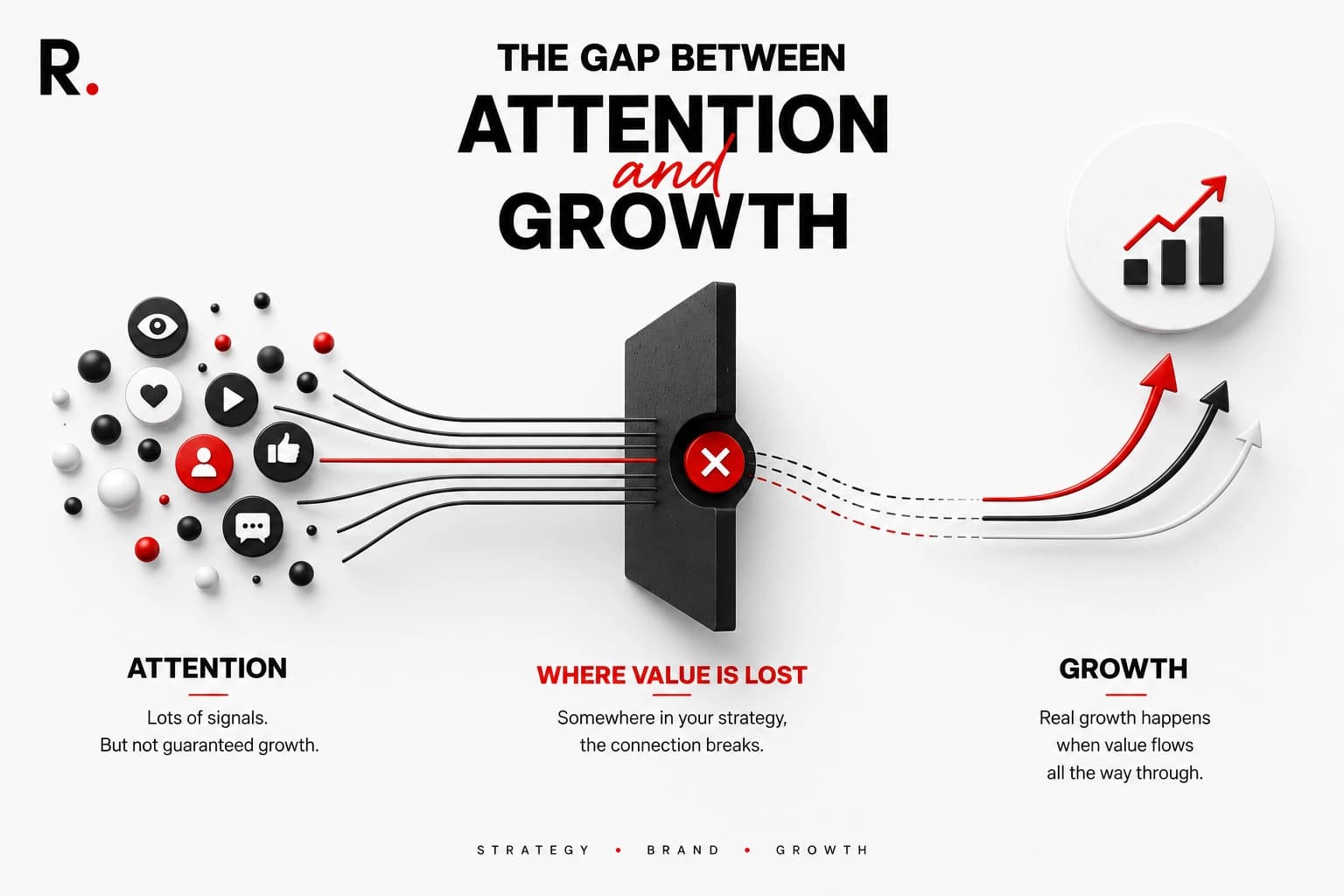
Where Does Your Marketing Stop Creating Value?
If your marketing isn't producing the growth you expect, don't immediately ask which new channel you should try. First, map the journey:
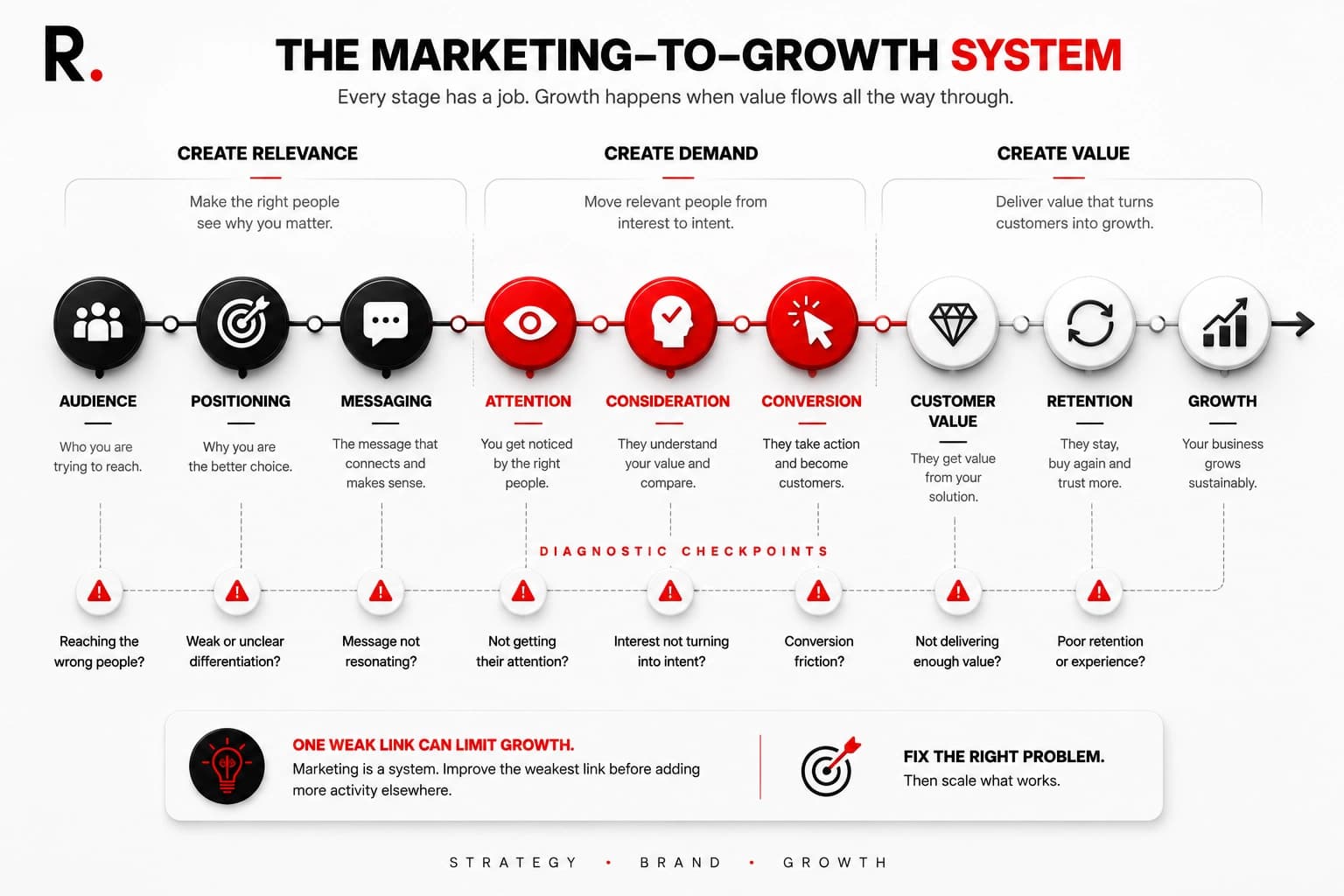
Audience → Positioning → Messaging → Attention → Consideration → Conversion → Customer Value → Retention → Growth
Each stage has a different job.
Your audience determines who you're trying to reach.
Your positioning determines why those people should see your business as relevant and different.
Your messaging communicates that value in a way they can understand.
Marketing then creates attention and moves relevant prospects towards consideration.
Your offer and customer journey need to turn that interest into conversion. After purchase, the business needs to create enough customer value to encourage retention, repeat business, and referrals. Only then does marketing contribute to sustainable growth.
This is why a healthy metric at one stage doesn't prove that the next stage is healthy. You can have high traffic without a compelling offer, high lead volume without qualified demand, or strong customer acquisition without healthy retention.
Marketing troubleshooting, therefore, isn't simply about asking whether a campaign performed well.
It's about finding where value stops being created or transferred from one stage to the next. When the system fails to produce growth, it is because a bottleneck has formed at one of those eight critical stages:
1. You're Reaching the Wrong People
One of the simplest explanations for marketing that gets attention without generating growth is that you're attracting the wrong attention.
A large audience isn't necessarily a valuable audience. Your marketing needs to reach people who have a problem your business can recognise and solve. They also need to fit your target market and have a realistic potential to become customers.
This is particularly important as buying journeys become more self-directed.
Gartner reported in 2026 that 67% of B2B buyers prefer a rep-free buying experience, while 45% said they had used AI during a recent purchase. Buyers increasingly encounter businesses through search, content, websites, AI tools, and other digital touchpoints before they ever speak to someone.
That makes audience and channel relevance increasingly important. Being present isn't enough. You need to be present where the right people are actually researching and evaluating solutions.
If you're seeing high reach but little relevant engagement, lots of traffic from outside your target market, or enquiries that repeatedly fail to match your ideal customers, you may not have an attention problem at all. You may have a relevance problem.
Look at your target audience, ideal customer profile, customer needs, buying intent, and channel-audience fit before trying to increase reach. The question isn't simply whether you're reaching more people. It's whether you're reaching more of the right people.
2. Your Positioning Doesn't Give People a Reason to Choose You
You can reach exactly the right audience and still struggle to generate growth. The reason is simple: being visible isn't the same as being distinctive.
Your positioning establishes how your business is understood relative to the alternatives available to your customer. It should help answer three basic questions:
Who is this for?
What problem does it solve?
Why should I choose it over the alternatives?
If those answers aren't clear, marketing has a difficult job.
Imagine two businesses offering broadly similar services. One communicates that it provides “high-quality solutions tailored to your needs.” The other clearly communicates who it specialises in serving, which problem it solves, what makes its approach different, and why that difference matters.
Both businesses may have competent marketing. But the second gives the customer a stronger reason to consider it. This is where brand strategy directly affects marketing performance. Marketing can amplify a position; it cannot reliably create a compelling position from nothing unless you have established your brand first.
You may have a positioning problem when prospects struggle to explain what makes you different, your messaging sounds interchangeable with competitors, customers compare you primarily on price, or people understand what you do without understanding why they should choose you.
In those situations, another campaign may simply make more people aware of an unclear proposition. The more fundamental question is whether your positioning, value proposition, and differentiation give the audience a compelling reason to move from awareness to consideration.
Not sure whether the problem is your positioning, messaging, or marketing strategy? Get a clearer view of where your brand is losing value and what needs to change → Talk to Restorefine
3. Your Marketing Gets Attention but Doesn't Create Enough Relevance
Audience and positioning aren't the same as messaging. You can reach the right people with a differentiated business and still communicate in a way that fails to resonate. That's the difference between attention and relevance.
Attention answers, “Did they notice us?” Relevance answers, “Did they see why this matters to them?”
Your messaging needs to connect what you offer with the problems, priorities, and desired outcomes of your audience. That means going beyond simply describing products or services and making the connection between what you provide and why the customer should care.
A technically impressive service isn't automatically a compelling proposition. A detailed description of your capabilities doesn't necessarily explain why those capabilities matter to a particular customer.
You may have a messaging problem if content gets views but rarely creates meaningful conversations, or if different channels communicate completely different versions of what your business stands for. There's an important distinction here between interesting and commercially relevant.
People can enjoy your content without needing your service. They can find a post useful without trusting you enough to buy. They can click on an advertisement without having any serious intention to become a customer. The objective isn't simply to make people interact with your marketing. It's to make the right people recognise themselves in it and understand why your solution matters.
4. Your Offer Doesn't Turn Interest Into Action
Suppose you've solved the audience, positioning, and messaging problems. People are arriving. They're interested. They're engaging. But they're still not taking action.
Now you need to investigate the offer and conversion layer. The transition is: Interest → Offer → Trust → Action
Your offer needs to make the next step sufficiently valuable and clear. That involves more than the product or service itself. It includes perceived value, credibility, proof, risk, calls to action, and the amount of friction involved in taking the next step.
This is where businesses often make a costly diagnostic mistake. Suppose a website receives plenty of relevant traffic but generates very few enquiries; the instinct is often to conclude that more traffic is needed. But if existing visitors aren't converting, additional traffic may simply produce more non-converting visitors.
Instead, investigate whether the visitor understands the offer, sees its value, has enough evidence to trust it, knows what to do next, and can complete that action without unnecessary friction. The issue may not be a lack of demand. It may be that the transition from interest to action isn't working.
5. The Customer Journey Is Breaking After the Click
Marketing doesn't end when somebody clicks. A prospect experiences a sequence: Search/ad/content → landing page → website → enquiry → sales → purchase → onboarding → delivery
Every transition creates another opportunity for value to be lost. Your marketing may promise one thing while the customer experience communicates something else.
For example, a business might position itself as simple and easy to work with, while its website is difficult to navigate, its enquiry process is unnecessarily complicated, and its response time is slow.
The marketing created the expectation. The experience failed to reinforce it.
This matters even more as buyers become increasingly comfortable researching and evaluating businesses independently. A 2026 study found that buyers used an average of seven information sources during a recent B2B purchase, while 70% preferred a completely digital, self-service buying experience.
That means your website, content, case studies, reviews, landing pages, and other customer-facing experiences increasingly participate in the marketing process, even when a marketer isn't directly involved.
So look for friction around your website navigation, landing pages, forms, calls to action, enquiry handling, sales handoffs, response times, and onboarding. Sometimes the marketing is doing its job. The next stage isn't.
6. You're Doing Marketing Without a Connected Strategy
Another common reason marketing doesn't generate growth is that there's plenty of activity but very little strategic connection between it. You may be doing SEO, social media, email marketing, paid advertising, content marketing, partnerships, and events. None of those activities is inherently wrong.
The problem is when they're treated as independent tasks rather than components of a larger system. A marketing strategy should establish who you're trying to reach, what problem you're solving, why your business is the right choice, what business outcome you're trying to create, what action the customer should take, and how success will be measured.
A channel is an execution mechanism. Strategy determines what role that channel plays. SEO might capture existing demand. Content might build understanding and trust. Email might nurture prospects. Paid advertising might accelerate acquisition. Your website might convert consideration into enquiries. When those roles are connected, channels reinforce one another.
When they're not, disappointing performance often leads to the same response: add another channel. That's how businesses end up with more activity without necessarily having more strategy.
Nielsen's 2024 Annual Marketing Report illustrates the same tension at an industry level. Its survey of nearly 2,000 marketers found that 70% planned to prioritise performance marketing over brand building, even though long-term and full-funnel ROI were among their top KPIs. Nielsen warned that shifting toward performance marketing without sufficient brand building could limit long-term ROI.
The lesson isn't that performance marketing is bad, or that brand marketing is automatically better. It's that individual tactics need to make sense within the broader commercial strategy.
7. You're Measuring Activity Instead of Business Outcomes
At some point, every marketing troubleshooting exercise comes back to measurement. Think of performance as a progression: Reach → Engagement → Demand → Conversion → Revenue → Customer Value → Growth
Each level answers a different question:
Reach asks whether people saw you.
Engagement asks whether they interacted.
Demand asks whether relevant people expressed interest.
Conversion asks whether that interest became customers.
Revenue asks whether those customers generated commercial value.
Customer value and retention tell you whether that value persists.
The problem occurs when a metric from one stage is used to judge another.
If the problem is that you're not generating qualified leads, impressions aren't the primary diagnostic metric. If you have plenty of qualified leads but few customers, traffic isn't the primary metric. If revenue is increasing but profitability is falling, lead volume alone tells you very little.
This is why the phrase “vanity metrics” can be misleading. A metric isn't inherently good or bad. Its usefulness depends on the business question you're asking.
So rather than asking which marketing metrics you should track, start by asking, 'What business question are we trying to answer?' Then choose the metric that can actually answer it.
8. You're Trying to Fix a Retention Problem With More Acquisitions.
There's another reason marketing can appear ineffective even when acquisition itself is working. You may be trying to acquire your way out of a retention or customer-value problem.
Imagine you're successfully generating new customers, but those customers don't stay, don't buy again, generate insufficient value, or require increasingly expensive acquisition to replace the ones leaving. Adding more acquisitions can temporarily increase customer numbers without creating healthy, sustainable growth. The broader relationship is:
Acquisition → Customer Value → Retention → Sustainable Growth
Retention, therefore, isn't simply a customer-service issue that happens after marketing. It affects the economics of the growth system itself.
Bain research has found that a 5% increase in customer retention can increase profitability by 40% to 95%, depending on the business context. The original Bain material also explains that retaining attractive customers can reduce acquisition spending, improve targeting, and increase opportunities for additional purchases.
While the reference figure above is relatively old, the underlying principle remains important: growth isn't simply about acquiring more customers; it's about creating enough value to retain valuable customers over time. If acquisition looks strong but the business still struggles to grow efficiently, investigate churn, repeat purchase behaviour, customer experience, customer lifetime value, and the reasons customers leave.
The leak may not be at the top of the funnel. It may be at the bottom.
How to Diagnose What Is Actually Wrong With Your Marketing
Once you've looked at the entire journey, troubleshooting becomes much easier. Instead of asking, “What marketing tactic should we try next?” start with: “What symptom are we seeing, and where is the most likely break?”
What You're Seeing (Symptom) | Investigate First (Bottleneck) | Underlying Diagnostic Cause |
High reach, low engagement | Audience & Relevance | Getting attention without resonance or alignment with audience needs. |
High traffic, low enquiries | Positioning, Offer & UX | Visitors arrive but find no compelling reason or clear path to act. |
High engagement, low conversion | Messaging & Offer | Content attracts casual interest without creating buying intent. |
Lots of leads, poor lead quality | Targeting & Positioning | Marketing messages attract unqualified prospects or wrong budgets. |
Good leads, low close rate | Offer, Trust & Sales Process | Demand exists, but conversion breaks during sales hand-off or evaluation. |
Good acquisition, poor retention | Customer Experience & Value | Growth is leaking post-purchase due to onboarding or delivery issues. |
Strong channel metrics, weak revenue | Strategy & Measurement | Tactical activity is disconnected from business growth drivers. |
Lots of activity, unclear results | Objectives & KPIs | Lack of clear performance definitions and baseline measurement. |
The table isn't intended to replace deeper analysis. It's a starting point for forming a hypothesis.
If you have high traffic but low enquiries, for example, don't automatically conclude that your offer is weak. Examine who is arriving, where they're coming from, what proposition they're seeing, what pages they visit, and where they leave. Then move through:Symptom → Hypothesis → Evidence → Action
That is a much more reliable troubleshooting process than changing tactics based on instinct.
Want to find where your Marketing Is losing momentum? Talk to Restorefine about your growth challenge →
Fixing the earliest broken link
There's one principle worth keeping throughout the process: Fix the earliest broken link before adding more activity downstream.
If you're reaching the wrong audience, don't optimise the conversion page first.
If your positioning is unclear, don't simply increase advertising spend.
If the offer is weak, more traffic won't necessarily help.
If conversion is healthy but retention is poor, increasing acquisition may simply make the underlying problem more expensive.
The closer the problem is to the beginning of the journey, the more downstream activity it can affect.
Don't Add More Marketing Until You Know What's Broken
When marketing isn't generating the growth you expected, the instinct is often to do more. More content. More social media. More advertising. More traffic. More leads. More channels.
But growth doesn't necessarily come from increasing activity. It comes from improving the system that turns activity into business value.
More traffic won't fix weak positioning.
More content won't fix an unclear offer.
More leads won't solve a conversion problem.
More acquisitions won't necessarily solve poor retention.
Before investing more, find the point where value is being lost.
Is it the audience? The positioning? The message? The offer? The customer journey? The strategy connecting your channels? The way you're measuring performance? Or what happens after the customer is acquired?
Once you know where the break is, you can make a much more informed decision about what to change. Because the goal isn't to make your marketing busier. It's to make the system connecting marketing activity to business growth work better.
Frequently Asked Questions
Why isn't my marketing working?
Your marketing may not be working because one or more parts of the system are disconnected. It can be your target audience and positioning for your messaging, offer, customer journey, conversion process, or measurement. Before adding more channels or increasing spend, identify where the journey from attention to business outcome is breaking down.
How do you solve a marketing problem?
Start by identifying the specific business outcome that isn't being achieved, then work backward through the marketing journey. Check your audience, positioning, messaging, offer, conversion path, customer experience, and measurement to find the bottleneck before changing tactics or adding more activity.
Why is my marketing generating traffic but no leads?
Traffic doesn't guarantee that you're attracting the right people or giving them a compelling reason to act. Low lead generation can result from an audience mismatch, unclear positioning, weak messaging or offers, ineffective calls to action, or friction on your website or landing pages.
How do I know if my marketing is working?
You should measure marketing against the business outcome it is intended to influence. Reach and engagement can indicate attention, but qualified leads, conversion, customer acquisition cost, revenue, retention, and customer value provide stronger evidence of whether marketing is contributing to growth.
Should I do more marketing if my current marketing isn't working?
Not necessarily. More activity can amplify an existing problem. If the audience, positioning, offer, conversion path, or customer experience is weak, increasing traffic or campaign volume may produce more activity without producing proportionate growth. You need to diagnose the bottleneck first.
Should I increase my marketing budget if my marketing isn't working?
No. Increasing spend can amplify an ineffective strategy. Before investing more, identify whether the problem is audience, positioning, messaging, conversion, customer experience, measurement, or another part of the marketing-to-growth journey.