


What Is a Brand Strategy?
A brand strategy is the long-term decision-making framework that shapes how a business is perceived, differentiated, and remembered by its target audience. It defines a company's core positioning, messaging, and value proposition, serving as the blueprint that aligns every future visual, messaging, and experience.
Rather than a static document or a set of design rules, a branding strategy is an active commercial system. It bridges high-level business objectives and everyday customer perception. Business strategy sets the direction a company is heading in; brand strategy governs how that journey is perceived along the way.
When most business leaders decide to invest in branding, they picture a logo, a color palette, and a sleek website. But a striking design with no strategy behind it is a facade with no foundation. It might grab attention briefly but fails to hold up under real competition.
To see this clearly, it helps to separate strategic decisions from tactical outputs:
Brand strategy defines where your business fits in the market, who your ideal customer is, what promise you make to them, and how you differentiate from competitors.
Brand identity is the visual and verbal expression of that strategy. It includes elements like logo, typography, colour palette, and tone of voice guidelines.
Marketing strategy refers to the promotional activities and channels used to amplify that strategy and reach target audiences.
Is Branding Strategy the same as Brand Identity?
No. A branding strategy is the overarching blueprint and positioning framework. Brand identity is the tangible visual and verbal expression created to execute that strategy. The design team builds identity from the strategy, not the other way around.
Basically, strategy defines the brand. Identity expresses it. Marketing communicates it.
When identity and marketing operate without a strategy behind them, efforts become fragmented and inconsistent. A well-defined brand strategy ensures every campaign, product release, and customer interaction reinforces one coherent brand promise.
Want a brand strategy that suits your brand? Check out the RestoRefine branding service today and choose a strategy that fits your brand.
Why Does Brand Strategy Matter?
In crowded markets, functional excellence and competitive pricing rarely secure market leadership on their own. Products get duplicated, and features get commoditized. A brand strategy creates value that's harder to copy: brand equity.
Drives meaningful differentiation: Without strategic positioning, businesses default to competing on price or features. This can be a race to the bottom that erodes the margin. A brand strategy identifies your unique value proposition and gives customers a value-based reason to choose you.
Builds trust and recognition: Trust comes from consistency. When messaging, visuals, and customer experience align across every channel, it signals reliability and turns casual buyers into loyal advocates.
Streamlines decision-making: A clear strategy acts as an internal compass for the team to act independently while staying aligned with the same goals. This matters more as a business grows, since without a shared reference point, different departments naturally drift toward their own interpretation of what the brand stands for.
Supports premium pricing: Strategically strong brands consistently command higher prices than unbranded competitors. Customers pay for perceived quality and reduced risk, not just the product itself.
Key takeaway: A brand strategy isn't about designing a better-looking brand. It's more about making better strategic decisions so every part of the business works toward the same long-term growth.

What Are the Core Components of a Brand Strategy?
Each component of a branding strategy answers a specific business question and shapes how your company shows up in the market.
Component | Business Question It Answers |
Brand Purpose, Vision & Values | Why do we exist, where are we going, and what do we stand for? |
Target Audience & Personas | Who are we serving? |
Brand Positioning | Why should customers choose us? |
Value Proposition | What unique value do we offer? |
Personality, Tone of Voice & Messaging | How do we sound, and what should people remember? |
Brand purpose, vision, and values establish the emotional and ethical baseline of a brand. A purpose is why the business exists beyond profit; vision is where it's going; and values are the principles guiding how it gets there.
Target audiences and personas keep a strategy from trying to appeal to everyone at once and prevent messaging from becoming diluted and forgettable. This involves mapping demographics alongside psychographic drivers, including motivations, pain points, and buying behavior.
Brand positioning defines the specific space your brand occupies in customers' minds relative to competitors. This includes your category, your unmet need, and your point of difference. Strong positioning usually comes from a genuine trade-off: choosing not to compete on certain fronts in order to own one clearly. This way, a business might trade broad appeal for depth in a single niche.
A value proposition is an explicit statement of the problem your business solves, the benefit it delivers, and why that's better than the alternatives. It should be specific enough that a competitor couldn't credibly copy and paste it. A generic value proposition is usually a sign that the underlying positioning hasn't been fully worked out yet.
Personality, tone of voice, and messaging translate the strategy into how the brand actually sounds, whether that’s in web copy, customer service, advertising, or internal communication, so the same story holds together no matter who's telling it.
Brand promise and brand architecture round out a full strategy, too. A brand promise is the consistent experience customers can rely on every time. Brand architecture governs how a business structures multiple products or sub-brands under one parent identity.
Neither is usually the starting point for a strategy, but both become essential as a business scales. A promise that isn't kept consistently erodes trust faster than almost anything else, and architecture decisions get exponentially harder to unwind the longer they're left undefined.
Key takeaway: These components only work as a system. A strong value proposition with no clear audience or sharp positioning, with inconsistent messaging, undermines the whole strategy.
Building a Brand Strategy: The Refined Brand Framework
Building a branding strategy isn't a one-off creative exercise but a structured process. We call ours the Refined Brand Framework: six steps that move from objective research to strategic definition to operational rollout.
Research: Start with facts, not assumptions. Audit existing touchpoints, evaluate competitor positioning, gather customer feedback, and identify gaps in the market.
Define the audience: Build detailed personas beyond basic demographics. Find out what frustrates your customers, what they're trying to achieve, and how they decide.
Position the brand: Map the competitive landscape, find where competitors fall short, and craft a value proposition targeted at your ideal customer's real pain point.
Develop messaging: Set 3–4 recurring messaging pillars and clear tone-of-voice guidelines so anyone writing on the brand's behalf sounds consistent.
Translate strategy into identity: Finally, brief the design team to build visual and verbal identity as a direct expression of the positioning already defined.
Implement and refine: Roll out the strategy across every touchpoint, document it in the brand guidelines, and track it against brand awareness, retention, and customer perception over time.
Key takeaway: A brand strategy is only as strong as the discipline behind steps 1–4. Skipping straight to step 5 is exactly how strategy-free branding happens.
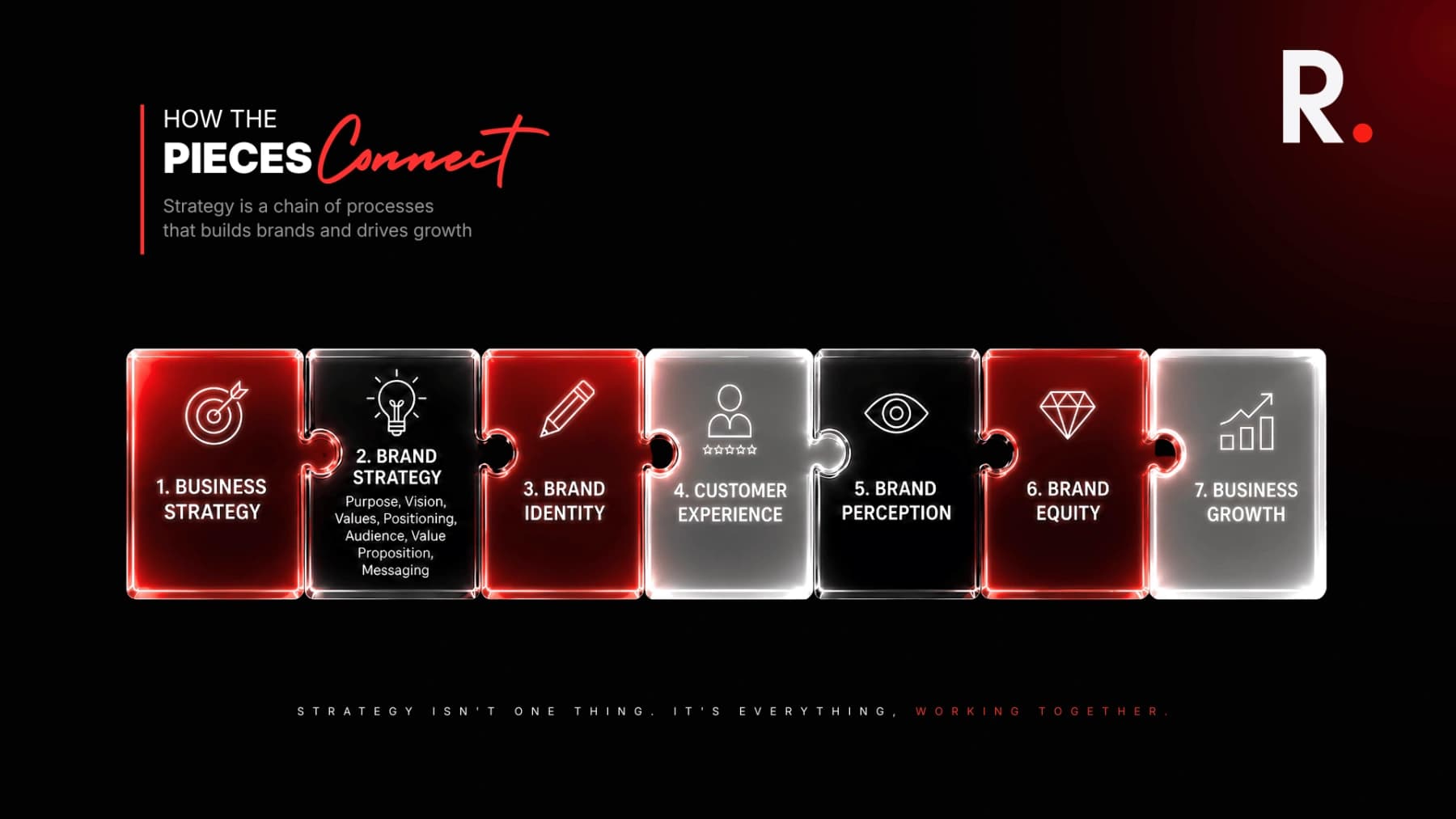
How the Pieces Connect
Every element of a brand strategy feeds into the next. So, strategy is a chain of processes:
Business Strategy → Brand Strategy (Purpose, Vision, Values, Positioning, Audience, Value Proposition, Messaging) → Brand Identity → Customer Experience → Brand Perception → Brand Equity → Business Growth
Differentiating Brand Strategy and Related Concepts
Business strategy and marketing strategy are both closely tied to brand strategy, but conflating them leads to misallocated resources.
In short: business strategy sets commercial direction, brand strategy translates that direction into customer perception, and marketing strategy executes it through campaigns and channels.
We have covered this relationship in full in our guide comparing business, marketing, and brand strategy. Worth a read if you're trying to untangle where responsibility for each sits inside your organization. Within brand strategy itself, two concepts are most often confused:
Concept | Primary Focus | Relationship to Brand Strategy |
Branding | The overall process of building brand presence | Guided by the strategy |
Brand Identity | Visual and verbal expression (logo, color, typography, voice) | Communicates the strategy |
Examples of Brand Strategy in Action
Apple doesn't compete on technical specs or price. Its strategy centers on human empowerment and premium simplicity. Their messaging is built around user experience rather than hardware, which sustains unusually strong loyalty and margin.
Nike built its strategy around athletic aspiration rather than footwear. "If you have a body, you are an athlete" reframes the product entirely. The brand sells movement and achievement, not shoes.
Volvo claimed one word: "safety" and never wavered. Rather than competing with BMW on performance or Mercedes on luxury, Volvo built decades of positioning around a single, defensible idea.
Strategy doesn't only play out at a global scale. When Blanc Events came to us, their branding no longer reflected the position they'd earned in their market. We rebuilt their strategy from the ground up with sharper positioning, a rebrand that actually communicated it, and a social campaign built to carry that positioning consistently across every channel. You can see the full case study on our portfolio page.
Beyond these familiar examples, brand strategy plays out differently depending on context.
In digital-first businesses, the strategy doesn't change, but digital channels become the primary way it's executed, from onboarding flows to social presence, all expressing the same positioning consistently at speed.
In B2B environments, brand strategy leans more heavily on trust and credibility than on emotional resonance, since buying decisions usually involve multiple stakeholders and longer sales cycles rather than a single consumer.
Corporate brand strategy adds another layer. They align an entire organization, often across multiple sub-brands or business units, under one coherent identity.
What Makes a Good Brand Strategy?
A strong brand strategy tends to share a few traits regardless of industry:
Clarity → It's simple enough that anyone in the business could repeat the core positioning back accurately.
Consistency → It holds together across every channel and touchpoint, not just the ones marketing controls.
Differentiation → It stakes out a position competitors can't easily claim, either.
Adaptability → It can flex with new markets or products without losing its core identity.
Measurability → Its impact can actually be tracked, not just felt.
If a strategy is missing more than one of these, it's usually a sign that the foundational work, like research or positioning, was rushed. These traits also tend to fail together rather than individually. A strategy that lacks clarity almost always lacks consistency too, since teams can't execute what they don't understand.
That's why the strongest strategies are usually the simplest ones, not because the underlying thinking is shallow, but because it's been refined enough to be stated plainly.
Common Brand Strategy Mistakes to Avoid
Executing identity before strategy. Designing visual assets before defining positioning leads to generic aesthetics that don't actually communicate anything.
Trying to appeal to everyone. Diluted, forgettable messaging is what happens when a brand refuses to pick a lane.
Inconsistent messaging across channels. Shifting tone or presentation between platforms undermines the trust consistency is supposed to build.
Copying competitors instead of differentiating. Following industry convention guarantees you'll look like everyone else.
Treating strategy as a one-off project. A strategy that's never revisited stops reflecting the business it was built for. A strategy built once and shelved gradually becomes a description of where the business used to be, not where it's actually heading.
Bringing Strategy and Growth Together
A brand strategy is far more than a creative exercise. It should also be the business asset that dictates how an organization competes, communicates, and grows. Prioritising strategic positioning before visual execution is what lets a business build genuine trust, defend its pricing, and hold a market position competitors can't easily copy.
If your business has a strong visual identity but no clear strategic direction behind it, that's usually the first thing worth revisiting before investing further in marketing or design.
Frequently Asked Questions
What is a branding strategy?
A branding strategy is a long-term plan that defines how a business wants to be perceived, differentiated, and remembered by its target audience. It guides decisions around positioning, messaging, identity, customer experience, and other brand touchpoints so they work toward a consistent business objective.
What are the key elements of a branding strategy?
The key elements typically include brand purpose, target audience, positioning, value proposition, brand personality, messaging, and brand identity. Together, these decisions establish what the brand stands for, who it serves, why it is different, and how that difference is communicated.
What is the difference between brand strategy and branding?
Brand strategy defines the direction a brand should take, while branding is the process of expressing and reinforcing that strategy through identity, messaging, experiences, and customer interactions. In simple terms, strategy determines what the brand should stand for; branding brings those decisions to life.
What is the difference between brand strategy and marketing strategy?
Brand strategy defines how a business should be positioned and perceived over the long term, while marketing strategy determines how the business reaches, engages, and converts its target audience. Marketing should therefore execute and reinforce the positioning established by the brand strategy.
How do you create a branding strategy?
A branding strategy can be developed by researching the market and audience, defining the brand's purpose and positioning, establishing its value proposition and messaging, translating those decisions into a consistent identity, and implementing and evaluating the strategy across customer touchpoints.
Why is a branding strategy important?
A branding strategy helps a business differentiate itself, communicate a clear value proposition, create consistent customer experiences, build trust, and strengthen long-term brand equity. It gives branding and marketing decisions a strategic direction rather than leaving them as disconnected creative or promotional activities.
How often should a brand strategy change?
A brand strategy should not normally change every time a campaign or trend changes. Core decisions such as purpose, positioning, and values should remain relatively stable, while messaging and execution can evolve as markets, audiences, competitors, or business objectives change. A major business pivot, new market, merger, or significant shift in customer expectations may justify a deeper strategic review.
How do you know if a brand strategy is working?
A branding strategy is working when the business develops clearer differentiation, stronger brand recognition, greater customer trust and loyalty, and more consistent experiences across touchpoints. Commercial indicators such as retention, customer preference, pricing power, and growth can provide additional evidence that the strategy is creating value.