


Introduction
Here's the uncomfortable truth: your best-performing content might be part of the problem, not the fix.
It always goes like this. A post takes off. Shares and comments roll in; your boss drops it in the team chat with a fire emoji. Then the next pipeline review rolls around, and someone asks the only question that actually matters: "Okay, but did it bring in anything?" The room goes quiet.
Attention tells you that someone noticed. Demand tells you that something has changed. Treating them as interchangeable is how a genuinely good content program ends up looking like it's failing, when really it's just working on a timeline nobody planned for.
This is about the gap between those two things:
What actually makes content create demand instead of just circulating?
How to build and measure the kind that does?
What Is Demand Generation Content?
Demand generation content is content designed to increase a target audience's awareness, understanding, trust, or preference around a problem, solution, or brand before they're anywhere near ready to buy.
It isn't a format. A blog post, a report, a video, and even a good social post can all do this job. Or none of them can. It depends on what the content changes in the person consuming it, not what container it arrives in.
Two distinctions are worth nailing down early, since most have a blurry understanding of them:
Demand generation isn't lead generation: Lead generation captures people who have already identified themselves as interested. It includes people who have filled out a form or booked a call. Demand generation creates the interest in the first place, often long before anyone's ready to hand over an email address.
Demand generation also isn't the same thing as content marketing: Content marketing is the broader discipline of creating and distributing content to attract and retain an audience. Demand generation is the commercial objective behind some of that content. It includes only the pieces built to change what someone understands, believes, or wants to solve.
This isn't a random strategy, either. Semetrical reports that content marketing generates roughly three times as many leads as traditional outbound marketing, at about 62% lower cost per lead. The efficiency case is well established. What's less established is why some content actually does this while other content just sits there looking busy.
Attention Isn't Demand
Four different things actually happen when someone encounters your content, instead of routinely lumping them as one:
Attention: "I noticed this."
Interest: "This is relevant to me."
Demand: "I care about solving this."
Intent: "I'm willing to act on this."
A person can read ten of your articles and never fill out a form, but that doesn't automatically mean the content failed. It might mean they're just quietly moving through attention, interest, and demand, without much intent other than getting informed.
Gartner's research on B2B buying backs this up: 75% of B2B buyers now say they'd prefer a fully rep-free purchase experience, meaning most of the journey happens without interacting with anyone from your team in the room, by the buyer's own choice.
The real mistake isn't publishing content that doesn't convert on day one. It's judging every piece by the same measuring stick, regardless of the job it was built to do.
What Actually Makes Content That Create Demand?
Content doesn't create demand because of its format. An Instareel isn't demand generation because it's a reel. Content creates demand when it moves a reader through a specific sequence. So, skipping a step is usually why "good" content underperforms:
It gets attention: The subject matters to the right person, not the widest audience.
It creates understanding: The reader sees their own situation more clearly than they did five minutes ago.
It changes perspective: They discover something they genuinely hadn't considered.
It builds trust: The content demonstrates real expertise, earned in the piece itself.
It increases perceived importance: The problem starts to feel more urgent or more expensive to ignore.
It creates preference: The reader starts to associate this specific solution or even the category with your brand.
It creates or strengthens intent: They become genuinely more willing to act.
Skip any of the seven steps, and you get attention without demand: someone who noticed you, nodded along, and moved on unchanged. Not a failed piece of content, necessarily, but an incomplete one.
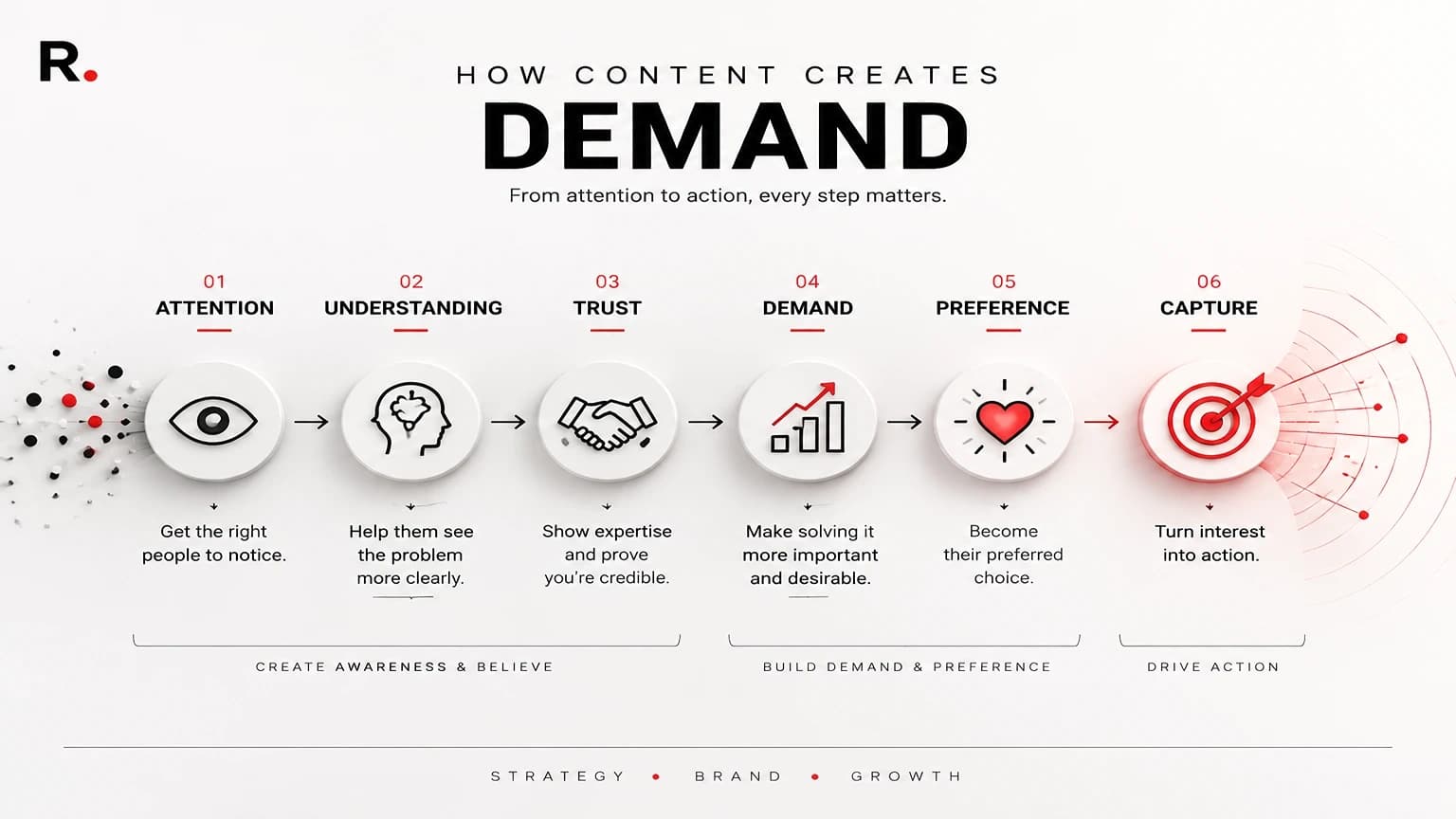
The Attention → Capture Framework
Stage | Content's job |
Attention | Get the right person to notice |
Understanding | Help them see the problem or opportunity clearly |
Trust | Demonstrate real expertise |
Demand | Increase how much the problem matters to them |
Preference | Make your brand the credible option |
Capture | Turn existing interest into action |
These are the six stages of the framework. Understanding and perspective are one job; making the reader see clearly is the next. Increasing importance is what demand actually requires, and intent is where capture takes over.
Each stage does different work on a different part of someone's thinking. A single piece can realistically handle two or three of them. Very few do all six, and that's fine. The goal is to know which job a given piece is actually built for before you create it.
What Types of Content Actually Generate Demand?
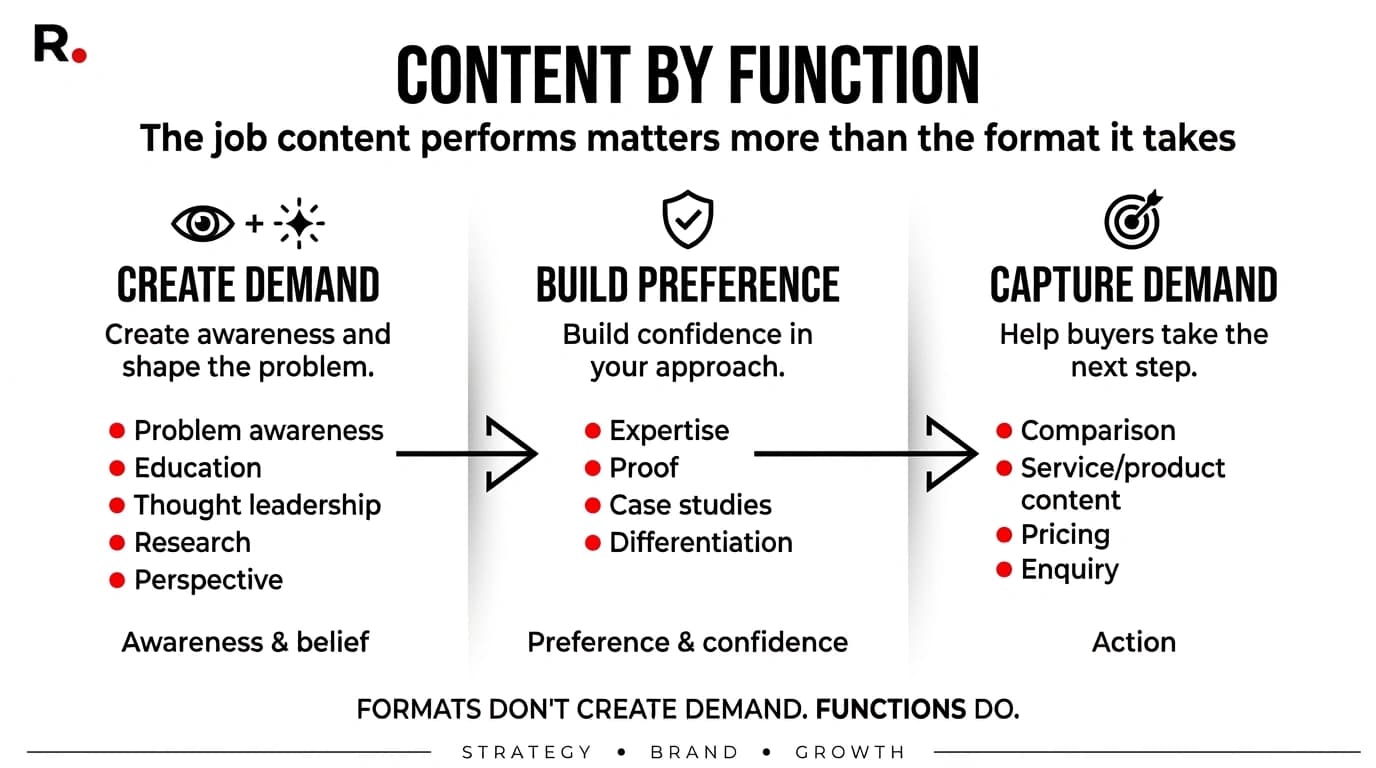
The usual answer is a list of formats: blogs, videos, webinars, and research. Not wrong, but incomplete, as the same format can do entirely different jobs depending on intent. A blog post can create demand or capture it. A photo can build craving or just get scrolled past. Format is the delivery mechanism. Function is what matters:
Problem-awareness content
Diagnostic articles, industry insights, and trend analysis. The main function is to name a problem they'd been living with, unnamed.
Solution-awareness content
Frameworks, how-to guides, and comparisons. The job is to show there's a real way through it.
Trust-building content
Original research, case studies, data, and consistent proof. The task is to prove you're what you claim to be.
Preference-building content
A strong point of view and a distinctive style. The function is to make your version the one they remember.
Demand-capture content
Comparison pages, service pages, pricing, and offers. The main function is to just be there, clearly, when they're ready to act.
A format doesn't inherently generate demand. Its effectiveness comes down to one question: does it change what the intended buyer understands, believes, or wants? If not, it's attention. If yes, it's demand generation content, regardless of what it's called on the CMS.
Demand Creation vs. Demand Capture
These are two different jobs, and mixing them up is one of the more expensive mistakes in content planning.
Demand creation asks, 'Make me care.' It's aimed at people who haven't recognised the problem yet or how much it costs them. Demand capture asks, ‘Help me act.’ It's aimed at people who already have intent and just need somewhere obvious to go.
An article titled "Why Your Marketing Isn't Working" creates problem awareness. A page titled "Marketing Strategy Consulting Services" captures demand that already exists. Both are necessary. A content plan that's all about capture without creating demand upstream eventually runs out of people who already care.
It's also why gating content too early tends to backfire. In Semrush's State of Content Marketing survey, only 17% of marketers rated gated content their best-performing type. Most of the real work of creating demand happens in content nobody has to unlock first. Save the gate for the moment someone's already decided to act.
How to Build a Demand-Generating Content Strategy
A workable sequence, roughly in order:
Define the audience. Not "everyone who might buy", but who specifically are you trying to create demand for?
Identify the problem. What are they actually experiencing, even unnamed?
Find the belief gap. What do they currently believe is quietly limiting them?
Build content around that gap, not just around a keyword or a calendar slot.
Match content to buyer awareness. Whether they're unaware, problem-aware, or solution-aware, evaluating each need is a different piece.
Distribute beyond the website. Search gets you found. Social media and communities get you seen by people who weren't looking.
Connect creation to capture. Once interest develops, give people somewhere obvious to go next.
Most strategies fall apart at step three. Teams jump straight to "What should we publish this month?", skipping the part where they figure out what the audience misunderstands. The result is content that's accurate while changing nothing.
The Hidden Demand Channel: Dark Social
Analytics show where traffic came from. They don't show where demand actually got created. Most real buying conversations now happen somewhere untrackable: private Slack channels, DMs, group chats, and forwarded screenshots.
A complete, useful idea that doesn't need a click to make sense gets shared in those conversations. You lose the visit in your analytics. You gain the actual conversation, which is the point. So, try to make your content part of the conversation.
How to Measure Demand Generation Content
Measurement should run across three tiers, not one:
Attention: impressions, reach, views, clicks.
Demand signals: branded search, returning visitors, repeat engagement, direct traffic.
Commercial outcomes: enquiries, opportunities, revenue, and self-reported attribution, or just simply asking new customers how they found you.
A piece of content can succeed at creating demand without directly producing a lead. Demand is often visible in returning visits, in someone searching your brand name, well before anyone fills out a form. That's a real signal, not an excuse to stop tracking outcomes.
If nothing you publish ever turns into results, the system needs fixing. So, you shouldn't judge any single piece against that bar alone. That's grading a seed by whether it's already a tree.
Why Your Content Gets Attention but Doesn't Create Demand
Run these against your own content, honestly:
Are you targeting attention instead of relevance?
High reach with the wrong audience looks like a win and is actually nothing.
Are you answering questions without creating perspective?
Useful information that doesn't change how someone thinks won't move them.
Are you selling before the context exists?
If the audience hasn't developed the problem yet, a pitch reads as noise.
Does each piece exist in isolation?
Content with no journey behind it can't build on anything, including itself.
Are you measuring engagement instead of demand?
Likes are a convenient stand-in, not the thing you're actually trying to move.
Are you producing formats instead of ideas?
A podcast isn't demand generation by default. It’s the idea inside that does the work.
A Real Example: Damasqino
We at RestoRefine have actually used this framework for many of our clients, including Damasqino.
Damasqino is a shawarma spot in Glasgow, and the goal was straightforward: become the best shawarma in the city. The tempting shortcut was the trend-chasing content, but it was good for views, not for orders. Nobody craves shawarma because a video went viral; they crave it because it looks like exactly what they want to eat.
So our strategic approach stayed close to the food. Consistent, genuinely appetising content. The kind of shot that gets you hungry mid-scroll. It was the understanding and trust work in a completely visual medium. No claims, just repeated proof that the food is what it looks like.
Then came timing. The World Cup campaign gave people a reason to think about Damasqino at the exact moment they were already excited about the matches: food. The demand of an ordinary craving turned specific and urgent, with Damasqino right there as the answer.
The part most local businesses get wrong is what happens after the spike. The momentum didn't stop when the tournament did. The content kept going, which is what turns a one-off spike into an actual habit. Damasqino becomes the default order, not just a good one during the World Cup.
None of it needed a benchmark report. It needed consistently good visual proof, timing matched to a real moment in people's lives, and enough follow-through that the interest didn't evaporate the day the campaign ended.

Start Measuring Beyond Vanity Attention
The goal was never content that gets noticed. It's content that makes the right people think differently about an opportunity or a craving, even if that shift happens quietly, off your dashboard, weeks before they say a word to you.
Attention gets you seen. Understanding gets you remembered. Trust gets you considered. Demand gets you chosen.
If you're not sure which stage your content is actually working at or where it's quietly breaking down, that's exactly what a Restorefine content strategy review is built to find.
Frequently Asked Questions
What is demand generation content?
Demand generation content is content designed to increase a target audience's awareness, understanding, trust, or preference around a problem, opportunity, or brand before they are ready to buy. It can include educational articles, research, thought leadership, videos, case studies, social content, and other formats designed to influence the buyer journey.
How does content marketing drive demand generation?
Content marketing drives demand generation by helping potential buyers understand problems, discover opportunities, evaluate possible solutions, and develop trust in a brand. The content does not necessarily need to produce an immediate lead but can influence awareness and preference before buying intent exists.
What type of content generates demand?
Content that generates demand typically does more than attract attention. It helps the audience recognise a problem, understand its importance, consider a new perspective, or become more confident in a solution. Common examples include educational content, original research, thought leadership, case studies, strategic guides, comparison content, and expert insights.
What is the difference between demand generation and lead generation?
Demand generation creates awareness, interest, and preference around a problem, solution, category, or brand, while lead generation focuses on identifying and capturing people who have shown enough interest to become prospects. Demand-generation content can therefore influence someone long before they are willing to submit a form or speak with sales.
What is the difference between demand generation and demand capture?
Demand generation creates or strengthens interest, while demand capture converts existing interest into action. Educational content can create demand by helping someone understand why a problem matters, whereas comparison, product, service, pricing, or enquiry content can help capture that demand once the buyer is actively looking for a solution.
Can content generate demand without generating leads?
Yes. Content can create demand without producing an immediate lead if it increases awareness, changes how someone understands a problem, builds trust, or makes a solution more relevant. Branded searches, returning visitors, repeat engagement, direct traffic, and later commercial interactions can provide evidence that demand is developing even when the original content did not generate a form submission.
How do you measure demand generation content?
You can measure demand generation content at three levels: attention, demand signals, and commercial outcomes. Attention includes reach, impressions, and engagement; demand signals can include branded searches, returning visitors, and repeat engagement; and commercial outcomes include enquiries, opportunities, pipeline, and revenue. No single metric captures demand generation on its own.