


Introduction
Every ambitious business eventually hits an invisible ceiling. The product is good, the team works hard, and the marketing budget keeps growing, but somehow the revenue stays flat.
The instinctive response is to either go for a new website, a freelance SEO contractor, or a bigger ad budget. But these individual, unaligned efforts rarely solve what is underneath: an architectural problem.
Businesses don't usually stall because they lack a good logo or a decent website. They stall because these functions operate in disconnected silos. And no amount of spending on any one of them closes the gap with the others.
Most business owners, when growth stalls, end up doing a job nobody hired them for: playing referee between a loose network of vendors. The web developer blames the ad agency. The ad agency blames the messaging. The copywriter blames the site. Everyone's individually right, though.
But the problem was never in any one of their hands to fix. This is the problem a business growth agency exists to solve. This guide explains what that means, how it differs from the agencies you already know, and how to tell if your business needs one.
What Is a Business Growth Agency?
A business growth agency is a strategic partner that unifies brand, content marketing, digital experience, and technology into a single system aimed at one outcome: sustainable revenue growth, not just isolated marketing metrics.
Where a traditional agency asks, "How many social posts do you need this month?" a growth agency asks a different question: What specific bottleneck is limiting your revenue, and how do we need to realign to remove it? The scope is the business's growth, not a single channel or deliverable.
What a business growth agency is not:
It's not just a marketing agency. It doesn't stop at campaigns and channels.
It's not just a branding agency. A logo and visual identity are a starting point, not the outcome.
It's not just a web design agency. A website is one component of a larger system, not the whole solution.
It's not a management consultancy. It doesn't just advise but builds and executes.
It's not a bundle of disconnected services. It knows that the value is in how the pieces connect, not in the individual pieces themselves.
Why Businesses Stop Growing: The Silo Effect
Most growth plateaus trace back to the same root cause: brand, marketing, technology, and customer experience operating as separate departments, without any shared system connecting them. This shows up in three consistent patterns:
The disconnected customer journey.
Social content looks polished and premium, but the click-through lands on a slow, confusing website. The credibility built in one channel is undone in the next.
A boutique hotel with a strong Instagram presence, for example, can still lose bookings to OTAs if its own booking flow doesn't match the trust it built on social.
Wasted marketing spend.
Paid traffic and SEO successfully drive visitors to the site, but generic positioning and untracked CRM data mean those visitors leave without converting. Premium traffic is poured into a leaky bucket.
A growing consultancy might have strong referrals, but if it has a website that undersells the business, every prospect who researches before calling in has already half-hesitated.
Invisible technical debt.
The business invests in good tools and platforms, but because marketing, website, and CRM don't talk to each other, the data stays fragmented. Nobody can say with confidence what customer acquisition cost, lifetime value, or true ROI actually are.
A retailer running profitable ads can still see rising acquisition costs if there's no CRM-driven retention system turning first-time buyers into repeat ones.
None of these are solved by doing more of the same tactic harder. They're solved by connecting the system.
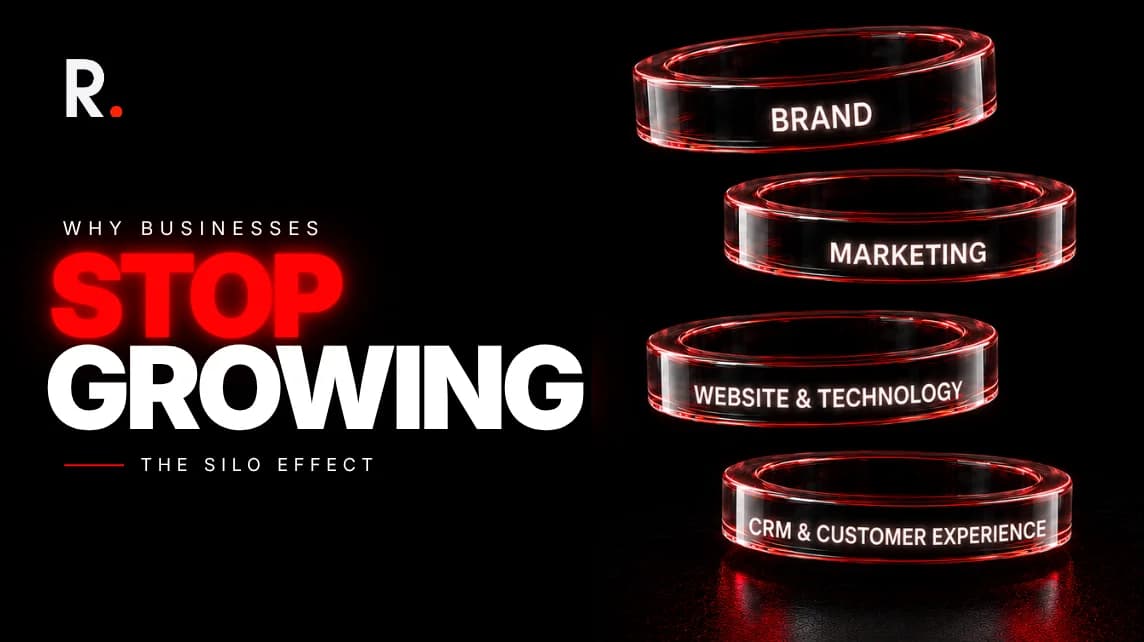
Now let’s look at our examples in practice
Hospitality
A boutique hotel group had strong Instagram engagement and decent ad spend, but direct bookings stayed flat while OTA bookings (Booking.com, Expedia) kept climbing. The gap wasn't in creative quality. It was that the website's booking flow, the CRM's follow-up on abandoned bookings, and the brand's case for booking direct over an OTA had no alignment. No amount of extra ad spend would have fixed a leak that was happening downstream of marketing entirely.
Professional services
A growing consultancy relied heavily on referrals, but its website and LinkedIn presence looked like a much smaller operation than it actually was. Prospects who researched the firm before a referral call often hesitated. The root cause was that brand positioning existed only in the founder's head, without being translated into consistent messaging across the website, proposals, and sales conversations. SEO wouldn't have closed a trust gap caused by inconsistent positioning.
Retail and e-commerce
A growing product business had profitable paid acquisition on a per-click basis, but the repeat purchase rate was low, and customer acquisition cost kept climbing. The problem wasn't ad targeting but their “no post-purchase system.” No email follow-up, no CRM segmentation, no retention offers. Every sale required fresh paid spend instead of building a customer base that came back on its own.
The common thread:
In each case, the obvious fix, such as better ads, a new website, etc., would have treated a symptom. The actual constraint was somewhere in the chain. This is precisely the kind of problem a single-service provider isn't positioned to see, let alone fix.
Business Growth Agency vs Other Types of Agencies
Agencies have historically evolved in step with what businesses have asked of them.
From pure execution toward strategic ownership of growth itself: Freelancer → Marketing Agency → Creative Agency → Business Growth Agency. Each stage solves a broader problem than the last. A freelancer executes a task.
Type of Agencies | Creative Agency | Digital/Marketing Agency | Business Growth Agency |
|---|---|---|---|
Primary focus | Aesthetics, brand assets | Traffic, clicks, campaign metrics | Revenue and long-term business value |
Delivers | Project-based assets (logos, guidelines) | Channel-specific campaigns (SEO, PPC) | End-to-end alignment of brand, marketing, and tech |
Technology | Minimal | Front-end ad dashboards only | CRM, automation, and tracking built in |
Strategic lens | Executes a fixed brief | Manages accounts against targets | Ties every asset back to business outcomes |
It's not like you should not hire creative or digital marketing agencies. They're simply solving a narrower problem than the one most stalled businesses actually have.
Defining How A Business Growth Agency Operate
Rather than treating strategy, brand, marketing, and technology as separate projects, a growth agency runs them through one connected process:
Phase | Focus | What Happens |
|---|---|---|
Discover | Audit | Map existing channels, tech stack, and where the customer journey currently breaks down |
Position | Brand strategy | Define positioning, messaging, and pricing so every channel says the same thing |
Build | Infrastructure | Build the website, brand assets, and backend tracking that will carry the strategy |
Launch | Go-to-market | Deploy SEO, content, and campaigns across channels in a coordinated way |
Measure | Data | Connect front-end traffic to CRM data, so acquisition cost and ROI are actually visible |
Optimise | Conversion | Test and refine the site and journey to remove friction, using real behavioural data |
Scale | Growth | Reinvest in what's working and extend the system into new segments or markets |
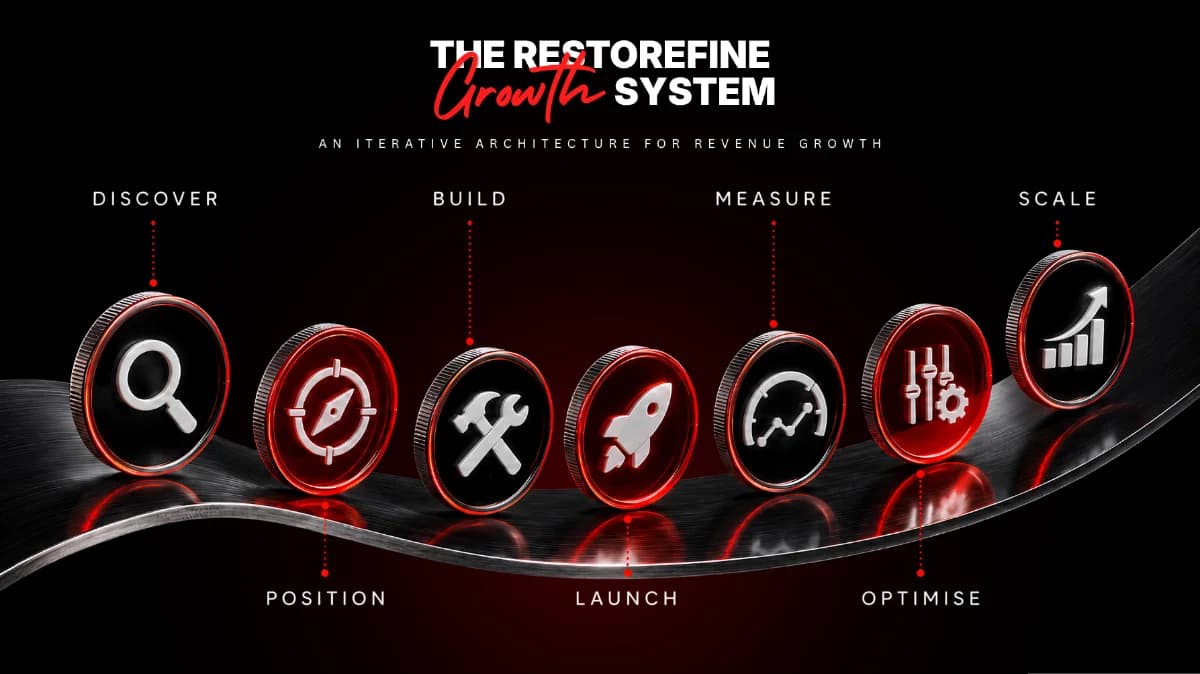
The Five Growth Drivers
Every business, regardless of size, grows through the same interconnected set of disciplines:
Strategy sets the direction.
Brand defines how the business is perceived.
Marketing brings in demand.
Website & digital experience convert that demand.
CRM & technology retain and compound it.
Strategy → Brand → Marketing → Website ⇄ CRM → Customer Experience → Growth
None of these disciplines needs to be individually exceptional. They simply cannot be individually broken, because a weak link anywhere caps the output of everything that follows it.
A strong ad campaign cannot outperform a website that fails to convert. A converting website cannot compensate for a CRM that never follows up.
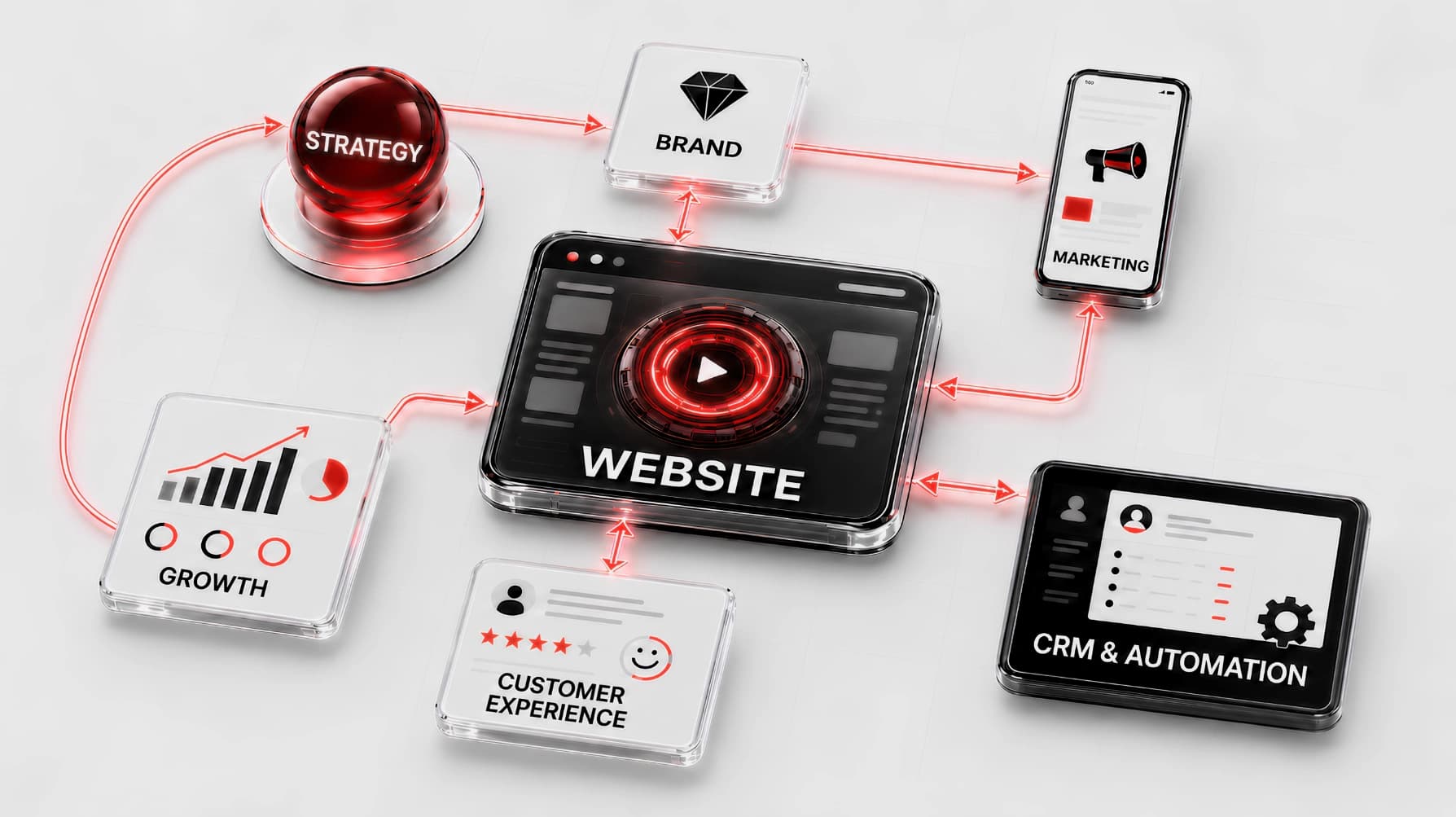
The Growth System above describes the sequence a business moves through when working with a growth agency. This ecosystem describes how the pieces stay connected once that process is complete. This also includes the ongoing back-and-forth between the website and CRM that keeps the system current rather than static, which is the difference between a project that concludes and a system that continues to work.
It helps to picture this as an ecosystem rather than a straight line: strategy sits at the center and feeds both brand and marketing. Brand and marketing each feed the website. From there, the relationship isn't strictly one-directional.
The website and CRM sync continuously, with the website capturing leads and the CRM feeding data and follow-up sequences back into the customer's experience of the site. That two-way exchange is what then feeds customer experience, which is where growth compounds.
What Services Does a Business Growth Agency Offer?
In practice, this system is delivered through three connected pillars. The services look familiar individually, but none of them are sold or scoped in isolation. Each is built against the same strategy and measured against the same outcomes.
Brand & positioning
Identity, messaging, and market positioning. The foundation everything else builds on. For hospitality and service businesses, this often extends beyond digital into physical touchpoints: menus, signage, print collateral, and packaging. This makes the brand feel consistent whether a customer meets it online or in person.
Marketing & acquisition
SEO, content strategy, paid media, and social. These are built to bring in demand so that the rest of the system is actually ready to convert. This is where most businesses already invest. So, a growth agency's contribution is less about running more campaigns and more about making sure the campaigns are pointed at a system that won't waste the traffic they generate.
Digital experience & technology
Website design and development, conversion rate optimization, CRM & marketing automation, and analytics & reporting. This pillar is where most agencies are at their weakest.
Many stop at "we'll build you a website" without touching what happens after someone visits it. A properly connected CRM is what turns a one-off visitor into a tracked, nurtured, repeat customer, and it's what finally makes it possible to answer questions like "what is our actual customer acquisition cost?" with a real number instead of a guess.
Who Needs a Business Growth Agency? The Business Growth Maturity Model
Growth doesn't stall because a business is "too small." It stalls at specific, predictable transition points, and the constraint is different each time.
Stage | Constraint | What's Needed |
Surviving | Validation, not visibility | Clarity on positioning before investing in scale |
Growing | Inconsistency | A repeatable system, not a founder-dependent effort |
Scaling | Fragmentation | Coordination across channels and vendors is already in play |
Optimising | Diminishing returns | Refining the system already built, not adding more of it |
Expanding | Repeatability at range | Infrastructure that scales without rebuilding from scratch each time |
Businesses at the “scaling stage” are often the ones that benefit most from the "optimize" phase of the growth system above. The two aren't a coincidence; they describe the same moment from two angles: where the business is and what to do about it.
Signs It's Time to Hire A Business Growth Agency
A few patterns tend to appear shortly before a business seeks out a growth partner:
Growth has visibly plateaued despite continued investment
Marketing activity is up, but revenue isn't following it
The brand feels inconsistent depending on where a customer encounters it
The website receives traffic but doesn't convert it
Multiple agencies or freelancers are involved, but nobody owns how they fit together
There is no single, shared view of what is actually driving results
Every new initiative feels like it's starting from scratch, rather than building on what already exists
Any one of these on its own might point to a narrower fix. Several of them together, particularly the last two, usually indicate a systems problem rather than a channel problem.
That distinction matters because a channel problem is solved by doing more of one thing better. A systems problem is only solved by connecting the things that already exist.
The latter is the specific gap a growth agency is built to close, and it's also why bringing one in earlier, rather than after every individual fix has already been tried, tends to save both time and budget.
Benefits of Working With a Business Growth Agency
A connected strategy instead of disconnected tactics.
Every channel and asset is built against the same positioning and goals, rather than being commissioned separately and hoping to be in alignment.
Consistent brand experience across every touchpoint.
A customer meeting the business on social, on the website, or in person encounters the same positioning and the same quality of experience each time.
Marketing spend that's traceable to actual revenue.
CRM and analytics are part of the system rather than an afterthought. This makes it possible to see which channels are actually driving revenue—not just which ones are generating clicks or impressions.
A website and CRM that convert and retain, not just exist.
The digital experience is treated as infrastructure for growth, not a static brochure that gets rebuilt every few years.
A system that scales with the business rather than needing to be rebuilt.
Because the pieces are connected from the start, expanding into a new segment or location extends the existing system rather than starting from zero each time.
How to Choose the Right Business Growth Agency
Look for a partner who asks about your business before your marketing. A genuine growth agency will want to understand your revenue goals, your current bottlenecks, and how your existing channels connect before even recommending any specific service.
Questions worth asking: You can ask the following or similar queries to check whether the agency is genuine or not:
Do you measure success in clicks or in revenue?
How do brand, marketing, and technology work together in your process?
Can you show how a past client's results connected back to business outcomes, not just campaign metrics?
Who on the team owns the system, versus who owns individual channels?
Red flags: Any agency that leads with deliverables before diagnosis, can't explain how their services connect, measures success only in vanity metrics like impressions and reach, or proposes a full rebuild of everything before understanding what's already working.
It's also worth matching the scale of the partner to the stage of the business. A business at the “surviving” or early “growing” stage typically needs less infrastructure and more clarity, with a smaller, more focused engagement.
A business at the “scaling” or “expanding” stage has more moving parts to coordinate and benefits from a partner with the technology and process maturity to manage that complexity without adding to the fragmentation it's trying to fix.
An agency that offers the same scope of engagement regardless of the business stage is usually optimizing for its own delivery model rather than the client's actual needs.
Final Thoughts
Isolated services don't create growth. It's created by aligning strategy, brand, marketing, digital experience, and technology into a single, connected system. That alignment, not any one tactic, is what a business growth agency exists to build.